Medical Foundations 3
Chapter 15Thyroid Examination
Part 1: Focused History – Based on Chief Complaint (Begin with Open-Ended Questions)
HPI, Associated Sx
FMHx/Personal Hx
- Hyperthyroidism: Graves’ Disease, Thyroid nodule, Hx of other autoimmune Dx (T1DM, RA, SLE, etc.)
- Hypothyroidism: Iodine Deficiency (developing countries); Hashimoto’s Thyroiditis (autoimmune)
Constitutional Hx
- Hyperthyroidism: Fatigue, Unintentional weight loss, ↑Appetite
- Hypothyroidism: Fatigue, Unexplained weight gain
Cardiovascular
- Hyperthyroidism: Tachycardia, palpitations
- Hypothyroidism: Bradycardia, palpitations
Gastrointestinal
- Hyperthyroidism: Frequent Bowel Movements
- Hypothyroidism: Constipation
Heat/Cold
- Hyperthyroidism: Heat intolerance (feeling warm in cold environments)
- Hypothyroidism: Cold intolerance (feeling cold in warm environments), Cold feet
Dermatological
- Hyperthyroidism: ↑ Sweating, Gynecomastia (male), Hair loss
- Hypothyroidism: Dry skin, Hair loss, Brittle nails, Moon face, Hertoghe Sign (lateral 1/3rd eyebrow loss)
Menstrual
Menstrual irregularities (thyroid disorders may variably present, including secondary amenorrhea and abnormal uterine bleeding)
Psychiatric
- Hyperthyroidism: Anxiety, Nervousness, Restlessness
- Hypothyroidism: Depression
Musculoskeletal
- Hyperthyroidism: Fine Tremor, Muscle weakness, Lid lag
- Hypothyroidism: Muscle and joint aches
GRAVES’ SPECIFIC
- Hyperthyroidism: Exophthalmos, Thyroid Acropachy (fingers/toe clubbing and soft tissue swelling), Pretibial Myxoedema
- Hypothyroidism: N/A
Mass Effects (Goiter)
Dysphagia, Dyspnea, Dysphonia, Dysarthria
Recall: Goiter can occur in any thyroid state – hyperthyroid, euthyroid, or hypothyroid
Past Medical History (PMHx)
- History of thyroid disorders, how patient found out (e.g. TSH testing with family doctor vs. hospitalization for thyroid storm), and prior management (e.g. radioactive iodine ablation treatment)
- History of other autoimmune or endocrine disorders
- History of radiation treatment to head, neck, or chest wall
- History of Amiodarone exposure (antiarrhythmic, high iodine content, toxicity risk for both hypo- and hyperthyroidism)
- History of Thyroid Cancer (e.g. Papillary - most common; Medullary; Follicular; Anaplastic)
Relevant Clinical Scores:
- Burch-Wartofsky Point Scale (BWPS) – predicts likelihood biochemical thyrotoxicosis is thyroid storm
Past Surgical History (PS Hx)
- Previous thyroid biopsies, partial or complete thyroidectomy
Family Medical History (FMHx)
- Thyroid Disorders: Graves’ disease (autoimmune)
- Thyroid Cancer: Example: familial medullary thyroid cancer in Multiple Endocrine Neoplasia Type 2 – MEN2
- Other Autoimmune Disorders: e.g. Addison’s, Myasthenia Gravis, Rheumatoid Arthritis, Lupus, Type 1 Diabetes
Social Hx
Smoking, Alcohol consumption dietary iodine deficiency (e.g. if raised in developing country; Canadian salt is iodine-fortified)
Medications & Allergies
Hypothyroidism
- Treatment: Thyroid Replacement (e.g. Levothyroxine)
- Common drugs that can cause hypothyroidism: Lithium, Amiodarone; checkpoint-inhibitor immunotherapy (e.g. in cancer treatment – pembrolizumab, ipilimumab, nivolumab); tyrosine kinase inhibitors (e.g. in cancer treatment – sunitinib, sorafenib, imatinib)
Hyperthyroidism
- Treatment: Thionamides (e.g. Methimazole, Propylthiouracil); Radioiodine therapy; Beta-blocker symptom support for hyperadrenergic symptoms (e.g. atenolol)
- Note: Excess thyroid replacement (e.g. Levothyroxine) can cause exogenous hyperthyroidism
Part 2: Pertinent Notes about the Physical Exam
- Patient Positioning: Should be seated during the Thyroid exam, with a glass of water re. swallow assessment for goiter.
- Patient Draping: Expose the neck from chin to level of manubrium & clavicles
Part 3: Specific Maneuvers in the Physical Exam – Say, Setup, Do, Report
Notes on Vitals
Vitals – Always do HR, BP, RR, Temp
In This Exam
AFMC level Pre-clerkship 4 · Clerkship 4
Hyperthyroidism:
- Tachycardia (HR >90 bpm – LR+ 4.4, LR- 0.2)
- Can’t Miss Diagnosis: Thyroid Storm – Febrile, Hypertension, Altered Mental Status, Tachyarrhythmia (e.g. atrial fibrillation), Congestive heart failure.
Hypothyroidism:
- Bradycardia (HR < 75 bpm – LR+ 4.1, LR- 0.8)
- Can’t Miss Diagnosis: Myxedema Coma – Hypothermia, Hypotensive, Coma, Bradycardia
Inspection
Head
AFMC level Pre-clerkship 3 · Clerkship 4
Say: I will inspect the eyes, eyebrows and hair to look for signs of thyroid issues. Please look straight ahead.
Hyperthyroidism: Look for Eyelid retraction (white of sclera visible at upper margin of cornea in direct outward stare), Exophthalmos and hair loss.
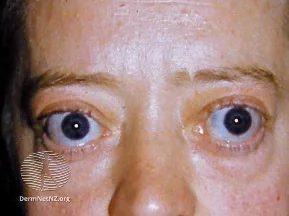
Exophthalmos2
Hypothyroidism: Look for hair thinning, Queen Anne’s Eyebrows/Hertoghe Sign (loss of outer 1/3rd of eyebrows), and periorbital puffiness.
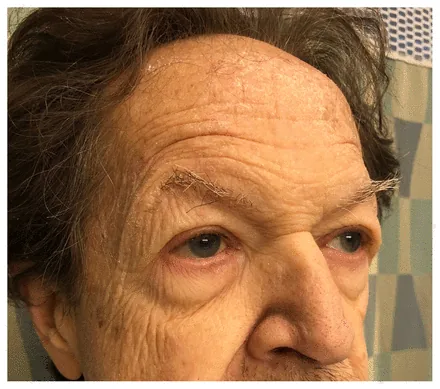
Queen Anne’s eyebrows3
Report: I note no signs of exophthalmos, hair thinning, Queen Anne’s eyebrows, or periorbital puffiness.
Why Check: The likelihood of suspected hyperthyroidism (particularly Grave's Disease) is greatly increased by eyelid retraction (LR+ 31.5, LR- 0.7). Both lid retraction and exophthalmos form part of the Wayne Index for Hyperthyroidism, where the likelihood of suspected hyperthyroidism greatly reduced for a score <11 (LR+ 0.04) and greatly increased for a score of >20 hyperthyroidism (LR+ 18.2). Alternatively, the likelihood of suspected hypothyroidism is slightly increased by loss of eyebrow hair (LR+ 1.9). Periorbital puffiness forms part of the Billewicz Score for Hypothyroidism, where the likelihood of suspected hypothyroidism is greatly reduced for a score of < -15 (LR+ 0.1), and greatly increased for a score of ≥ 30 (LR+ 18.8).
Neck
AFMC level Pre-clerkship 3 · Clerkship 4
Say: I will inspect the neck for signs of thyroid issues. Please look straight ahead. When you can, please swallow.
Do: Expose neck from chin to level of manubrium & clavicles. Look at neck from both sides, looking for an obvious mass or goiter. Have patient take a sip of water and swallow – the thyroid should move up and down as patient swallows. If no goiter visible, have patient extend their neck and repeat inspection.
Report: I note no obvious mass or goiter. The thyroid is mobile on swallowing.
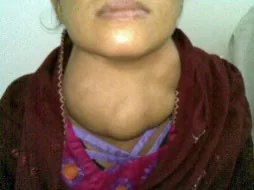
Goiter4
Why Check: A goiter may be present with hyperthyroid, euthyroid or hypothyroid disease. A goiter detected by palpation and visible on inspection with neck in neutral position (non-extended) greatly increases the likelihood of the presence of goiter (LR+ 26.3); a goiter detected by palpation but only visible on inspection with neck extended does not significantly alter the likelihood of the presence of goiter. An enlarged thyroid mildly increases the likelihood of suspected hyperthyroidism (LR+ 2.3, LR- 0.1), and of suspected hypothyroidism (LR+ 2.8, LR- 0.6). The absence of an enlarged thyroid decreases the likelihood of both as well.
Modification for Patients with Obesity: Ask the patient to look up at the ceiling when inspecting their thyroid. This is because stretching the neck tissue can help to make the thyroid more prominent during inspection.
Skin
AFMC level Pre-clerkship 1 · Clerkship 2
Say: I will inspect the hands, forearms and elbows to look for signs of thyroid issues.
Hyperthyroidism: Assess for moist and warm skin.
Hypothyroidism: Assess for cool and dry skin, or coarse skin. Look for wrist puffiness, and dry or brittle nails.
Report: I note no moist and warm, or cool and dry skin. The nails are not dry or brittle, with no wrist puffiness.
Why Check: Thyroid disease can often manifest as changes in the skin. The likelihood of suspected hyperthyroidism is moderately increased by moist and warm skin (LR+ 6.7, LR- 0.7). Both hands hot and hands moist form part of the Wayne Index for Hyperthyroidism, where a score of <11 greatly reduces the likelihood of suspected hyperthyroidism (LR+ 0.04) and a score of >20 greatly increases the likelihood of suspected hyperthyroidism (LR+ 18.2). Alternatively, the likelihood of suspected hypothyroidism is slightly increased by cool and dry skin (LR+ 4.7, LR- 0.9), by coarse skin (LR+ 3.4, LR- 0.7), and by wrist puffiness (LR+ 2.9, LR- 0.7). Both coarse skin and cold skin form part of the Billewicz Score for Hypothyroidism, where a score of < -15 points greatly reduces the likelihood of suspected hypothyroidism (LR+ 0.1), and a score of ≥ 30 points greatly increases the likelihood of suspected hypothyroidism (LR+ 18.8).
Fine Tremor of Hands (hyperthyroidism)
AFMC level Pre-clerkship 2 · Clerkship 4
Say: I will inspect the hands. Can you stretch your arms out, with palms down and with fingers separated?
Setup: Need a piece of paper available
Do: Place piece of paper on top of hands and observe for fine tremor of fingers.
Report: No fine tremor of fingers observed.
Why Check: The presence of fine finger tremor greatly increases the likelihood of suspected hyperthyroidism (LR+ 11.4, LR- 0.3), and also forms part of the Wayne Index for Hyperthyroidism, where a score of <11 greatly reduces the likelihood of suspected hyperthyroidism (LR+ 0.04) and a score of >20 greatly increases the likelihood of suspected hyperthyroidism (LR+ 18.2).
Pretibial Myxedema (hyperthyroidism)
Say: I will now assess the lower legs below the knee, in particular the front of the legs and top of the feet for skin changes for signs of thyroid issues.
Do: Look for peau d’orange appearance (waxy, discoloured induration of skin); usually begins at anterior aspect of lower legs, spreads to dorsal surface of feet; can progress to the upper extremities too.
Report: I note no abnormal skin discolorations such as peau d’orange to suggest thyroid disease.
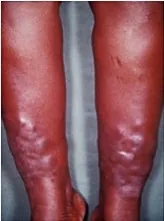
Pretibial Myxedema5
Why Check: Pretibial myxedema is a rare complication of Graves’ disease (hyperthyroidism).
Palpation
Thyroid Gland
AFMC level Pre-clerkship 3 · Clerkship 4
Say: I will palpate the thyroid. I will need to place my hands on the neck to examine the thyroid. I will ask you to swallow a sip of water when you can at points. Please tell me if you are in discomfort.
Setup: Have glass of water available. Stand either in front of, or behind patient (patient comfort-dependent).
Note: Monitor for signs of patient discomfort here and stop the exam if the patient is in distress.
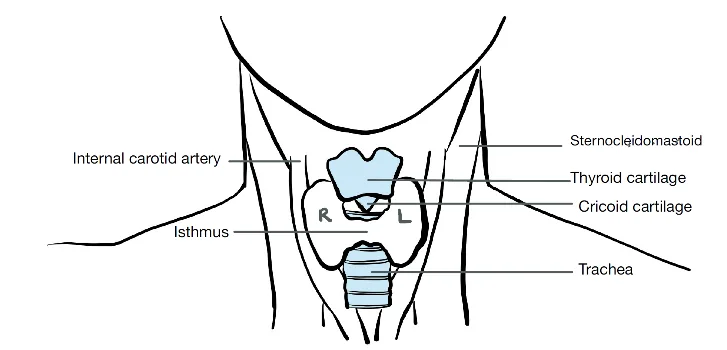
Do:
- Landmark for Isthmus: Find the thyroid cartilage (first big bump, in males it’s the Adam’s Apple) → Move inferiorly to Cricoid Cartilage (second big bump, after a space) → palpate just below that → found the isthmus.
- Palpating gland → Once found the Isthmus, push the sternocleidomastoids out of the way on one side with that hand; with other hand, palpate around the area laterally to the isthmus you found Technique: sometimes easier to approach patient posteriorly for this (for example, landmark with right finger the isthmus, push left sternocleidomastoids out of way with left hand, and with right finger move laterally to palpate)
- Assessment → Assess for size, nodularity, consistency, shape/symmetry, and tenderness
Report: Thyroid gland is small, non-palpable, non-tender without nodules
Why Check: A goiter may be present with hyperthyroid, euthyroid or hypothyroid disease. An enlarged thyroid mildly increases the likelihood of suspected hyperthyroidism (LR+ 2.3, LR- 0.1), and of suspected hypothyroidism (LR+ 2.8, LR- 0.6). The absence of an enlarged thyroid decreases the likelihood of both as well.
Typical presentations:
- Grave’s Disease (Hyperthyroid): Soft, diffusely enlarged, and soft with no nodules
- Hashimoto’s Thyroiditis (Hypothyroid): Firm, diffusely enlarged, and slightly tender with no nodules
- Malignancy: Firm, singular nodes
- Iodine Deficiency: Multinodular goiter
Percussion
Retrosternal Goiter
Say: I will percuss near the sternum (point on yourself to where you will percuss) for signs of thyroid issues.
Do: Percuss over sternum, looking for dullness as evidence of a retrosternal goiter.
Report: I note no dullness to percussion over the sternum.
Why Check: A retrosternal goiter is a thyroid gland/goiter that has extended posteriorly into the mediastinum rather than anteriorly and is more occult. Percussion may thus help assess a goiter’s extent in thyroid disease.
Auscultation
Thyroid Bruits (hyperthyroidism)
AFMC level Pre-clerkship 3 · Clerkship 4
Say: I will auscultate for bruits in the thyroid gland using the diaphragm of my stethoscope. Can you take a deep breath in and hold it for a moment as I listen?
Do: Auscultation of each of the two lobes of the thyroid
Report: I note no bruits on auscultation of the thyroid gland.
Why Check: Hyperthyroidism may present with localized and continuous bruits. In practice, doppler ultrasound may help in assessing for increased thyroid perfusion and bruits as well. A bruit over thyroid forms part of the Wayne Index for Hyperthyroidism, where a score of <11 greatly reduces the likelihood of suspected hyperthyroidism (LR+ 0.04) and a score of >20 greatly increases the likelihood of suspected hyperthyroidism (LR+ 18.2).
Special Tests
Lid Lag Test (Hyperthyroidism)
Say: Please follow my fingers (stand > 1 m away) without moving the head.
Do: As you raise and lower your fingers, watch both the eyes and eyelids. Negative (normal) when the lids and eyes movements are synchronized. Positive (abnormal) when the lids move slower than the eyes.
Report: Lid Lag Test is negative, with eyes and lids moving together simultaneously.
Why Check: Grave’s Disease (hyperthyroid) may present with ocular manifestations, such as exophthalmos, lid retraction and lid lag. Eyelid lag greatly increases the likelihood of suspected hyperthyroidism (LR+ 17.6, LR- 0.8). Lid lag also forms part of the Wayne Index for Hyperthyroidism, where a score of <11 greatly reduces the likelihood of suspected hyperthyroidism (LR+ 0.04) and a score of >20 greatly increases the likelihood of suspected hyperthyroidism (LR+ 18.2).
Pemberton’s Sign
Say: Please raise both arms straight above the head and keep them elevated for 1 minute.
Do: As patient raises arms, look for signs of facial congestion and cyanosis, as well as respiratory distress.
Report: I note no facial congestion, cyanosis, or respiratory distress with Pemberton’s Sign
Why Check: Pemberton’s Sign assesses for symptoms of Superior Vena Cava obstruction (e.g. congestion) occurring here secondary to mass effect from enlarged thyroid gland/goiter.
Proximal Muscle Weakness (Hyperthyroidism)
AFMC level Pre-clerkship 3 · Clerkship 4
Say: Please sit on the floor. Now, can you stand up without using either arm to support you?
Do: Assess whether patient able to comply with instructions or require arm support. Alternative method: have patient sit in a chair initially, and then stand without using their arms.
Report: No evidence of proximal muscle weakness
Why Check: May be suggestive of hyperthyroidism, which can cause myopathy. The proximal muscles are those closer to the trunk, and aid in gross movements such as standing.
Deep Tendon Reflexes
AFMC level Pre-clerkship 3 · Clerkship 4
(Explored in Ch 31 – Screening Neuro Exam – MF4)
Say: I will now be checking the deep tendon reflexes for signs of thyroid issues using a reflex hammer. Please keep the joints relaxed.
Do: Patellar reflex (knee), Brachialis reflex (Biceps), Triceps reflex, Achilles reflex. Also perform the plantar response (should normally see downward of big toe; Babinski = upgoing plantar response). Assess for bilateral symmetry of reflexes, briskness of the response, and clonus. If patient’s reflex is difficult to elicit, can try the Jendrassik Maneuver (patient’s teeth clenched, fingers interlocked, and pull on the count of 3) for distraction. Clonus = seizure of the reflex (normal to see 2 beats of flapping of the foot).
Grading: 0 = Absent; 1+ = Hypoactive (or requiring Jendrassik Maneuver); 2+ = Normal; 3+ = Hyperactive, no Clonus; 4+ = Hyperactive, with Clonus (repeating reflex)
Report: I note normal Grade 2+ Deep tendon reflexes in all 4 limbs.
Why Check: Hyperreflexia (3+ or 4+) may suggest hyperthyroidism. Alternatively, hyporeflexia (0 or 1+; specifically with a delayed relaxation phase) may suggest hypothyroidism. In particular a delayed ankle reflex mildly increases the likelihood of suspected hypothyroidism (LR+ 3.4, LR- 0.6). A slow ankle jerk forms part of the Billewicz Score for Hypothyroidism – score <-15 pts greatly reduces likelihood of suspected hypothyroidism (LR+ 0.1), and score ≥ 30 pts greatly increases likelihood of suspected hypothyroidism (LR+ 18.8).
Helpful Stethopedia Videos to Review
- Video 1 – Thyroid Exam OSCE Style (Link: https://videopress.com/v/nig3T68L)
Part 4: Relevant Likelihood Ratios – from Rational Clinical Examination JAMA series
Clinical Question 1: Does this patient have Hypothyroidism?6
| Procedure | LR+ (95% CI) | LR- (95% CI) |
|---|---|---|
| Hypothyroid speech | 5.4 (2.7-10.7) (about +30%) | 0.7 (0.5-0.9) (about −15%) |
| Cool and dry skin | 4.7 (3.1-7.1) (about +15%) | 0.9 (0.8-0.9) (about −15%) |
| Slow pulse rate | 4.1 (3.2-5.3) (about +15%) | 0.8 (0.7-0.8) (about −15%) |
| Delayed ankle reflexes | 3.4 (1.8-6.4) (about +15%) | 0.6 (0.4-0.9) (about −15%) |
| Coarse skin | 3.4 (1.4-8.0) (about +15%) | 0.7 (0.5-0.9) (about −15%) |
| Puffiness of wrists | 2.9 (1.7-4.9) (about +15%) | 0.7 (0.5-0.9) (about −15%) |
| Enlarged thyroid | 2.8 (2.3-3.4) (about +15%) | 0.6 (0.6-0.7) (about −15%) |
| Hair loss of eyebrows | 1.9 (1.1-3.6) (about +15%) | 0.8 (0.7-1.0) (no change: 95% CI includes 1) |
| Periorbital puffiness | 1.7 (0.7-4.2) (no change: 95% CI includes 1) | 0.6 (0.4-0.8) (about −15%) |
| Cold palms | 1.6 (1.0-2.7) (no change: 95% CI includes 1) | 0.8 (0.6-1.1) (no change: 95% CI includes 1) |
| Dry palms | 1.5 (1.0-2.4) (no change: 95% CI includes 1) | 0.8 (0.6-1.1) (no change: 95% CI includes 1) |
| Pretibial edema | 1.1 (0.9-1.5) (no change: 95% CI includes 1) | 0.7 (0.3-1.6) (no change: 95% CI includes 1) |
| Slow movements | 1.0 (0.8-1.2) (no change: 95% CI includes 1) | 1.0 (0.3-3.2) (no change: 95% CI includes 1) |
| Billewicz score less than -15 points | 0.1 (0-0.2) (about −45%) | N/A |
| Billewicz score -15 to +29 points | 0.9 (0.4-2.1) (no change: 95% CI includes 1) | N/A |
| Billewicz score +30 points or more | 18.8 (1.2-300.5) (about +45%) | N/A |
Billewicz Score for Hypothyroidism (Referred to Above)6:
| Finding | Score If Present | Score if Absent |
|---|---|---|
| Symptom | ||
| Diminished Sweating | +6 | -2 |
| Dry Skin | +3 | -6 |
| Cold Intolerance | +4 | -5 |
| Weight Increase (e.g. recorded increase in weight or tightness in clothing) | +1 | -1 |
| Constipation | +2 | -1 |
| Hoarseness | +5 | -6 |
| Paresthesia | +5 | -4 |
| Deafness | +2 | 0 |
| Sign | ||
| Slow Movements (e.g. while removing/replacing buttoned garment) | +11 | -3 |
| Coarse Skin (e.g. roughness, thickening of skin of hands, forearms, elbows) | +7 | -7 |
| Cold Skin | +3 | -2 |
| Periorbital Puffiness | +4 | -6 |
| Pulse Rate <75 bpm | +4 | -4 |
| Slow Ankle Jerk (with patient kneeling on chair) | +15 | -6 |
Clinical Question 2: Does this patient have Hyperthyroidism?6
| Procedure | LR+ (95% CI) | LR- (95% CI) |
|---|---|---|
| Eyelid retraction | 31.5 (16.6-59.7) (about +45%) | 0.7 (0.6-0.7) (about −15%) |
| Eyelid lag | 17.6 (9.2-33.7) (about +45%) | 0.8 (0.8-0.8) (about −15%) |
| Fine finger tremor | 11.4 (8.7-14.8) (about +45%) | 0.3 (0.3-0.4) (about −30%) |
| Skin moist and warm | 6.7 (5.0-9.1) (about +30%) | 0.7 (0.7-0.7) (about −15%) |
| Pulse >90 beats/min | 4.4 (3.8-5.1) (about +15%) | 0.2 (0.2-0.3) (about −30%) |
| Enlarged thyroid | 2.3 (2.1-2.5) (about +15%) | 0.1 (0.1-0.2) (about −45%) |
| Wayne index <11 points | 0.04 (0-0.3) (about −45%) | N/A |
| Wayne index 11-19 points | 1.2 (0.7-2.0) (no change: 95% CI includes 1) | N/A |
| Wayne >20 points | 18.2 (2.9-113.5) (about +45%) | N/A |
Wayne Index for Hyperthyroidism (Referred to Above)6
| Finding | Score If Present | Score if Absent |
|---|---|---|
| Symptom | ||
| Dyspnea on Effort | +1 | N/A |
| Palpitations | +2 | N/A |
| Tiredness | +2 | N/A |
| Preference for Heat (Irrespective of duration) | -5 | N/A |
| Preference for Cold | +5 | N/A |
| Excessive Sweating | +3 | N/A |
| Nervousness | +2 | N/A |
| Appetite Increased | +3 | N/A |
| Appetite Decreased | -3 | N/A |
| Weight Increased | -3 | N/A |
| Weight Decreased | +3 | N/A |
| Sign | ||
| Palpable Thyroid | +3 | -3 |
| Bruit Over Thyroid | +2 | -2 |
| Exophthalmos | +2 | N/A |
| Lid Retraction | +2 | N/A |
| Lid Lag | +1 | N/A |
| Hyperkinetic Movements | +4 | -2 |
| Fine Finger Tremor | +1 | N/A |
| Hands Hot | +2 | -2 |
| Hands Moist | +1 | -1 |
| Casual pulse rate: Atrial fibrillation | +4 | N/A |
| Casual pulse rate <80, regular | -3 | N/A |
| Casual pulse rate 80-90, regular | 0 | N/A |
| Casual pulse rate >90, regular | +3 | N/A |
Clinical Question 3: Does this patient have a Goiter?7
| Procedure | LR+ (95% CI) |
|---|---|
| No goiter by palpation or inspection | 0.4 (about −30%) |
| Goiter by palpation, visible only after neck extension | Not Significant |
| Goiter by palpation and inspection with neck in normal position | 26.3 (about +45%) |
References
-
Recommendations. Choosing Wisely Canada. Accessed August 1, 2022. https://choosingwiselycanada.org/recommendations/#list ↩
-
Hyperthyroidism. DermNet NZ. Accessed February 21, 2023. https://dermnetnz.org/topics/hyperthyroidism ↩
-
Kobylianskii K, Gold WL. Queen Anne sign. CMAJ. 2022;194(6):E219. ↩
-
File:Goitre.jpg. Wikimedia Commons. Accessed April 1, 2023. https://commons.wikimedia.org/wiki/File:Goitre.jpg ↩
-
File:Myxedema.jpg. Wikimedia Commons. Accessed May 2, 2023. https://commons.wikimedia.org/wiki/File:Myxedema.jpg ↩
-
McGee S. Evidence Based Physical Diagnosis. Saunders; 2012:813-814. ↩ ↩2 ↩3 ↩4
-
McGee S. Evidence Based Physical Diagnosis. Saunders; 2022:199-214. ↩

