Medical Foundations 1
Chapter 3Equity-Deserving Populations Primer
Introduction
Beginning with fourth edition of the McMaster Clinical Skills Guide, important steps forward include integration of social justice in medicine concepts into the McMaster Clinical Skills Curriculum. This work is the result of excellent efforts by the Social Justice in Medicine (SJIM) working group, working with the Clinical Skills Guide editors. Throughout the text you will find integrated links to different equity-deserving populations, along with changes to the structure of Chapters in a similar spirit. The following Primer should serve as a reference for students for a common vocabulary when equity-deserving populations with colleagues and with patients. It is not intended to be an exhaustive list.
Part 1: General Definitions for Equity-Deserving Populations
Social Justice1
A concept based on a vision of society in which the distribution of resources is equitable, and individuals and groups are given equal opportunity, fairness, civil liberties, and participation in the rights, freedoms and responsibilities valued by society.
Equality1
Practice of ensuring equal treatment to all people, without consideration of individual/group diversities.
Equity1
The practice of ensuring fair, inclusive and respectful treatment of all people, with consideration of individual and group diversities. Access to services, supports and opportunities and attaining economic, political and social fairness cannot be achieved by treating individuals in exactly the same way. Equity honours and accommodates the specific needs of individuals/ groups.
Oppression1
The obvious and subtle ways dominant groups unjustly maintain status, privilege and power over others, using physical, psychological, social or economic threats or force. Frequently an explicit ideology is used to sanction the unfair subjugation of an individual or group by a more powerful individual or group, which causes injustices in everyday interactions between marginalized groups and the dominant group.
Internalized Oppression1
When members of a marginalized group accept negative aspects of stereotypes assigned to them by the dominant group and begin to believe that they are inferior. The incorporation by individuals within an oppressed group of the prejudices against them within the dominant society can result in self-hatred, self-concealment, fear of violence, feelings of inferiority, resignation, isolation, and powerlessness. It is a mechanism within an oppressive system for perpetuating power imbalance.
Intersectionality1
When two or more oppressions overlap in the experiences of an individual or group, creating interconnected barriers and complex forms of discrimination that can be insidious, covert and compounded. This term was first coined by Kimberlé Williams Crenshaw, an American civil rights advocate and leading scholar of critical race theory.
Privilege1
Unearned power, benefits, advantages, access and/or opportunities that provide unfair advantage for members of the dominant group(s) in society. People are not always aware of the privileges they have. Examples include: cisgender privilege, straight privilege, male privilege, white privilege.
Passing2
When generally used, describes when someone is seen as a member of an identity or social group that may be different than their own; generally this identity that others perceive them as is that of a less marginalized group. For specific definitions of passing with regards to race and gender, see terms and definitions below.
“---“-ism1
Harmful beliefs, behaviours or institutional practices by a group or person with power directed against specific groups, rationalized by an underlying belief that certain people are superior to others. (e.g. Ableism, Ageism, Antisemitism, Audism, Cissexism, Classism, Ethnocentrism, Heterosexism, Racism, Sexism, Shadism, Sizeism, etc.)
“---“-phobia1
A dislike, aversion, or an extreme, irrational fear and/or hatred of a particular group of people. It is expressed through beliefs and tactics that devalue, demean and terrorize people. (E.g. biphobia, homophobia, Islamophobia, transphobia, xenophobia, etc.)
Stigma3
Severe social disapproval or discontentment with a person or group on grounds of their particular circumstance usually based on differences from social or cultural norms. Stigma and discrimination are not only products of attitudes, values, beliefs & practices of individual practitioners, but are also bred through policies, procedures, culture and environment of service organization. A comprehensive approach is therefore needed to reduce stigma and discrimination within health and social service settings.
Allyship4
Allyship is an active, consistent, and arduous practice of unlearning and re-evaluating, in which a person in a position of privilege and power seeks to operate in solidarity with a marginalized group. Allyship is not an identity - it is a lifelong process of building relationships based on trust, consistency and accountability with marginalized individuals and/or groups of people.
Social Determinants of Health (SDH)3
Social determinants of health are specific to the social and economic conditions that shape the health of individuals, communities and countries. They influence the extent to which individuals have the physical, social and personal resources to achieve their goals, satisfy their needs, and cope with their environments. In Canada, 12 social determinants of health are recognized: (1) Physical environment; (2) Employment and working conditions; (3) Social environment; (4) Social support networks; (5) Health services; (6) Culture; (7) Income and social status; (8) Education and literacy; (9) Personal health practices and coping skills; (10) Healthy child development; (11) Biology and genetic endowment; and (12) Gender.
Race1
Culturally or socially constructed divisions of humankind, based on distinct characteristics that can be based on physicality, culture, history, beliefs and practices, language, origin, etc. Racial discrimination is prohibited within Canada as part of the Canadian Human Rights Act, and the United Nations has a committee devoted to the elimination of racial discrimination.
Racism vs. Racial Prejudice5
A set of discriminatory or derogatory attitudes based on assumptions deriving from perceptions about race and/or skin colour. Thus, racial prejudice can be directed at white people, but is not considered racism because of the systemic relationship of power. When backed with power, prejudice results in acts of discrimination and oppression against groups or individuals. In Canada, white people hold this cultural power due to Eurocentric modes of thinking, rooted in colonialism, that continue to reproduce and privilege whiteness.
Interpersonal or Relational Racism6
When individuals experience some form of discrimination on a personal level in their daily lives. This could range in severity from being treated poorly or differentially from others to overt forms of violence. It can be intentional or unintentional.
Systemic Racism6
Systemic racism occurs in societies where one social group has disproportionate access to power and resources in society, leading to avoidable and unfair inequalities between these groups. This imbalance of power and resources is maintained through inequitable treatment under the law and unfair policies, rules and regulations. It is commonly manifested in social exclusion and isolation that limits or prevents political, social and economic participation, or access to and participation in other social systems such as education and health. Interpersonal or relational racism fuels the perpetuation of systemic racism.
Passing (Race)7
Occurs when someone presents themselves as, or is read as by others, as a member of a different racial group. White passing specifically refers to "individuals who physically appear white to society, regardless of speech or behaviour. They are ultimately presumed to be white."
Culture1
The sum of many things an individual learns (and may modify or pass on) from being immersed in a particular context – the shared (or perceived to be shared) ideas, beliefs, values, behavioural norms, knowledge, customs and traditions of a group of people who share some historical, geographic, religious, racial, linguistic, ethnic or social context.
Culturally Safe Care6
Emphasizes explicit attention and action to address power relations between the service user and provider. This practice requires that the patient’s way of knowing and being is respected as valid; that the patient is a partner in the healthcare decision-making process; and that the patient determines whether or not the care received is culturally safe.
Ethnicity1
A socially defined category or membership of people who may share a nationality, heritage, language, culture and/or religion.
Poverty8
According to the Government of Canada, poverty “is the condition of a person who is deprived of the resources, means, choices and power necessary to acquire and maintain a basic level of living standards and to facilitate integration and participation in society.”5 Poverty is understood to be multi-dimensional including material (lacking access to or skills to acquire sufficient material and financial resources to thrive); social (isolation, lacking formal and informal supports necessary to be resilient in times of crisis and change); and spiritual (lacking meaning in their lives and connection to a faith community that sustains them)6. Considering Canada's wealth and resources, a disproportionate number of Canadians are living in poverty. Poverty affects millions of Canadians. Many more live precariously from paycheque to paycheque and are at risk of falling into poverty. Child poverty rates are not declining, and food security is an issue for far too many. It is estimated that over 150,000 Canadians are homeless on any given day.
Homelessness9
Homelessness describes the situation of an individual or family without stable, permanent, appropriate housing, or the immediate prospect, means and ability of acquiring it. It is the result of systemic or societal barriers, a lack of affordable and appropriate housing, the individual/household’s financial, mental, cognitive, behavioral or physical challenges, and/or racism and discrimination. Most people do not choose to be homeless, and the experience is generally negative, unpleasant, stressful and distressing. Homelessness encompasses a range of living situations including unsheltered, emergency sheltered, provisionally accommodated, or at risk of homelessness.
Housing Instability10
Housing instability has no standard definition, encompassing a number of challenges including trouble paying rent, overcrowding, moving frequently, staying with relatives, or spending the bulk of household income on housing (>30% of income on housing = cost-burdened, >50% = severely cost-burdened). A recent study (Sandel et al. 2018. Unstable Housing and Caregiver and Child Health in Renter Families. Pediatrics, 141(2): 2017-2199) delineated 3 important forms of housing instability – behind on rent, multiple moves, and current homelessness. It also emphasized that rent strain (behind on rent) is the most prevalent form of housing instability with little overlap with multiple moves or homelessness.
Housing First11
A recovery-oriented approach to ending homelessness that centers on quickly moving people experiencing homelessness into independent and permanent housing and then providing additional supports and services as needed. The basic underlying principle of Housing First is that people are better able to move forward with their lives if they are first housed.
Food Security12
Food security exists when all people, at all times, have physical and economic access to sufficient, safe and nutritious food to meet their dietary needs and food preferences for an active and healthy life. Household food insecurity is the inability to acquire or consume an adequate diet quality or sufficient quantity of food in socially acceptable ways, or the uncertainty that one will be able to do so.
Motivational Interviewing1314
A directive, client-centred counseling style for eliciting behavior change by helping patients to explore and resolve ambivalence11. Principles include12:
- Express Empathy Through Reflective Listening: Shows acceptance, increases chance of patient and clinician developing rapport.
- Develop Discrepancy: Enables the patient to see their present situation does not necessarily fit into their values and what they would like in the future.
- Roll with Resistance: Prevents a breakdown in communication between patient and clinician and allows the patient to explore their views.
- Support Self-Efficacy: When a patient believes that they have the ability to change, the likelihood of change occurring greatly increases. The patient, not the clinician, is responsible for choosing and carrying out change.
Stages of Change (Transtheoretical Model)15
Focuses on decision-making of the individual and is a model of intentional change. States that at any time, for any behavior, a person is in one of the following stages of behavior change:
- Precontemplation: The patient is not intending to change their behavior. For practical purposes, time horizon as not planning to change is defined as within the next 6 months.
- Contemplation: The patient has not begun to change their behavior but intends to do so within the next 6 months.
- Preparation: The patient has not begun to change their behavior but intends to do so in the next 30 days (e.g. has set a quit date).
- Action: The patient has changed their behavior in the past 30 days (e.g. has quit)
- Maintenance: The patient has practiced this new behavior for at least 30 days.
STBBI3
STBBIs encompass sexually transmitted infections (STIs) and other blood-borne infections (BBIs). STIs are transmitted by sexual activity or exposure (e.g. chlamydia, gonorrhea, syphilis, etc.). BBIs are transmitted by direct blood contact from one individual to another through injured skin or a mucous membrane, and also transmitted through drug use and sexual contact (e.g. HIV, hepatitis A, B, and C).
Part 2: Definitions for Specific Equity-Deserving Populations
Patients of Different Body Habitus
Weight Bias16
Negative attitudes and views about obesity and about people with obesity. It can be experienced in explicit, implicit and internalized forms.
Weight Stigma16
Social stereotypes and misconceptions about obesity. These social stereotypes and misconceptions include beliefs that people with obesity are lazy, awkward, sloppy, non-compliant, unintelligent, unsuccessful and lacking self-discipline or self-control.
Weight Discrimination16
When persons enact personal biases and social stereotypes about obesity and treat people with obesity unfairly. This includes verbal and emotional discrimination; physician discrimination; barriers in day-to-day life (e.g. undersized chairs in public locations, lack of appropriate-sized medical equipment such as BP cuffs, gowns); and can include denial of access to treatment or patients avoiding seeking help from the healthcare system.
Fatphobia17
Fatphobia, also known as anti-fat, is the implicit and explicit bias of overweight individuals that is rooted in a sense of blame and presumed moral failing. Being overweight and/or fat is highly stigmatized in Western Culture. Anti-fatness is intrinsically linked to anti-blackness, racism, classism, misogyny, and many other systems of oppression. Anti-fatness contributes to individuals not receiving adequate healthcare for a number of reasons, including:
- (1) the assumption is if someone is overweight, they cannot be healthy
- (2) clinical care teams typically lack experience in treating diverse body sizes
- (3) weight related structural barriers, e.g., size of exam tables, gowns, blood pressure cuffs, and scale limits.
Patients with Disabilities
Disability18
A physical or mental condition that limits a person’s movements, senses or activities.
Intellectual & Developmental Disabilities (IDD)19
Various life-long limitations in intellectual functioning and conceptual, social or practical skills that emerge in persons before the age of 18 years. These limitations differ in severity and type among people with IDDs and can vary during a person’s lifespan. Intellectual and Developmental Disabilities encompass intellectual disability, developmental disability, learning disability, and autism spectrum disorder.
Neurodiversity, Neurotypical2021
Neurodiversity describes the idea that people experience and interact with the world around them in many different ways. There is no one “right” way of thinking, learning and behaving, and differences are not viewed as deficits. Neurodiversity is a term often used in the context of autism spectrum disorder (ASD) as well as other neurological or developmental conditions such as attention deficit hyperactivity disorder (ADHD) or learning disabilities18. Between 30-40% of the population are thought to be neurodiverse, with the remaining majority considered neurotypical19.
Medical vs. Social Models of Disability22
| Medical Model | Interactional or Socio-Political Model |
|---|---|
| Disability is a deficiency or abnormality. | Disability is a difference. |
| Being disabled is negative. | Being disabled, in itself, is neutral. |
| Disability resides in the individual. | Disability derives from the interaction between the individual and society. |
| Remedy for disability-related problems is cure or normalization of individual. | Remedy for disability-related problems is a change in the interactions between the individual and society. |
| Agent of the remedy is the professional. | Agent of the remedy is the individual, an advocate, or anyone who affects arrangements between individual and society. |
Accessibility18
Refers to design of products, devices, services, or environments for people who experience disabilities. Ontario has laws to improve accessibility for people with disabilities, including Accessibility for Ontarians with Disabilities Act (AODA), the Ontario Human Rights Code (OHRC), and the Ontario Building code.
Barrier18
A circumstance or obstacle that keeps people apart or prevents participation. For people with disabilities, barriers can take many forms including attitudinal, communication, physical, policy, programmatic, social and transportation.
Behaviors that Challenge (BTC)23
Occur when health, developmental and social needs of individuals with IDDs might not be fully understood, necessary supports are not available, when expectations might be inappropriate, and when needed environmental accommodations are not made. This framework situates such behavior in the context of interactions between people with IDD who have unique developmental needs, and their environments and supports.
Accommodation1
An adjustment made to policies, programs and/or practices to enable individuals to benefit from and participate in the provision of services equally and perform to the best of their ability. Accommodations are provided so that individuals are not disadvantaged on the basis of the prohibited grounds of discrimination identified in the Ontario Human Rights Code or other similar codes. Accommodation with dignity is pursuing the principle that our society should be structured and designed for inclusiveness.
Person-First Language24
Person-first language is used to speak appropriately and respectfully about an individual with a disability or chronic illness. Person-first language emphasizes the person, with phrases such as: “a person who …”, “a person with …” or, “person who has…”
Note: Not all people with disabilities like to use this language. You should always mirror the language people use for themselves or check with them if you are unsure of what language they would like you to use when speaking to/about them.
LGBT2SQ+ Patients
(Note: For current terminology, visit https://www.rainbowhealthontario.ca/glossary/#I)
Table 1 – Sexuality and Gender Concepts
Sex Assigned at Birth1
What someone identifies you as when you are born based on external genitalia. This may be male, female, or intersex.
Sex1
Sex is determined by a combination of internal and external genitalia, chromosomes, hormones, genes, and secondary sex characteristics (for example breasts or facial hair). Many of these things are not visibly apparent on some people, and a few of them also are not apparent until after people are much older (i.e., during or after puberty). People may fall into one or multiple sex categories (male, female, and intersex) as these exist on spectrums and (for example) people’s hormone levels may not necessarily correspond with what we expect based on their external genitalia, etc. Also, characteristics that correspond to different sexes have been arbitrarily assigned and categorized, in other words, sex is a social construction. For example, many individuals categorized as female have facial hair, but generally we say that that is a ‘male’ characteristic.
Sexuality3
Sexuality is more than sexual activity. It is made up of complex and dynamic forces that influence an individual’s sense of identity, social well-being and personal health. It involves sex, gender identities and role, sexual orientation, eroticism, pleasure, intimacy and reproduction. It is experienced and expressed through thoughts, fantasies, desires, beliefs, attitudes, values, behaviors, practices, roles and relationships.
Sex-Positivity3
Adopting a sex-positive approach means respecting the wide range of human sexuality. It involves talking with patients openly and without judgment about their sexuality. A sex-positive approach respects the sexual rights of all persons, and also acknowledges that not everyone has learned about or experienced sexuality in a positive and affirming way.
Sexual Attraction and Orientation25
Sexual attraction is attraction that makes people desire sexual contact or shows sexual interest in another person(s). Sexual orientation is about who you are sexually attracted to.
Romantic Attraction and Orientation25
Romantic attraction is attraction that makes people desire romantic contact or interaction with another person or persons. Romantic orientation is about who you are romantically attracted to. For individuals who experience sexual attraction, their sexual orientation and romantic orientation are often, although not always, in alignment (i.e. they experience sexual attraction toward individuals of the same gender(s) as the individuals they are interested in forming romantic relationships with).
Gender1
Gender is based on the expectations and stereotypes about behaviours, actions, and roles linked to being a “man” or “woman” within a particular culture or society. The social norms related to gender can vary depending on the culture and can change over time.
Gender Identity1
A person’s internal and individual experience of gender. It is a person's sense of being a woman, a man, both, neither, or anywhere along the gender spectrum. A person's gender identity may be the same as or different from their birth-assigned sex. A person's gender identity is fundamentally different from and not related to their sexual orientation.
Gender Expression1
How a person publicly expresses or presents their gender. This can include behaviour and outward appearance such as dress, hair, make-up, body language and voice. A person's chosen name and pronoun are also common ways of expressing gender. Others perceive a person's gender through these attributes. All people, regardless of their gender identity, have a gender expression and they may express it in any number of ways.
Gender Spectrum1
The representation of gender as a continuum, as opposed to a binary concept. This spectrum is also multi-dimensional, and not necessarily a linear spectrum from man to woman.
Gender Binary1
A social system whereby people are thought to have either one of two genders: “man” or “woman.” These genders are expected to correspond to their sex assigned at birth: male or female. In the gender binary system, there is no room for living between genders or for transcending the gender binary. The gender binary system is rigid and restrictive for many people whose sex assigned at birth does not correspond with their gender, or whose gender is fluid and not fixed.
Gender Norms1
The gender binary influences what society considers “normal” or acceptable behaviour, dress, appearance and roles for women and men. Gender norms are a prevailing force in our everyday lives. Strength, action, and dominance are stereotypically seen as “masculine” traits, while vulnerability, passivity, and receptiveness are stereotypically seen as “feminine” traits. A woman expressing masculine traits may be chastised as “overly aggressive,” while a man expressing “feminine” traits may be labelled as “weak.” Gender norms can contribute to power imbalances and gender in equality in the home, at work, and in communities.
Gender Role1
The oppressive culturally and historically specific expectations and restrictions that are placed on a person based on whether they are assigned at birth as male or female.
Cisnormativity1
Cisnormativity (“cis” meaning “the same as”) refers to the commonplace assumption that all people are cisgender and that everyone accepts this as “the norm”. The term cisnormativity is used to describe systemic prejudice against trans people. This form of systemic prejudice may go unrecognized by the people or organizations responsible.
Heteronormativity1
Refers to commonplace assumption that all people are heterosexual and that everyone accepts this as “the norm”. The term heteronormativity is used to describe prejudice against people that are not heterosexual and is less overt or direct than homophobia and more widespread or systemic in society, organizations, and institutions. This form of systemic prejudice may even be unintentional and unrecognized by people or organizations responsible.
Misogyny1
The hatred and denigration of women and characteristics deemed feminine.
Passing (Gender)26
Passing describes the experience of a transgender person being seen by others as the gender they want to be seen as, and/or being seen by others as cisgender. Passing can be important for trans people for emotional reasons (affirmation of gender), as well as for safety reasons such as protection from harassment and violence. However, not all trans people feel the same way about passing, as some people feel the word itself suggests that some people’s gender presentation isn’t as real as others, or that trans people are trying to deceive other people. Some people may also feel that passing implies that being seen by others as cisgender is more important than being known as transgender. Some people may also not want to pass as cisgender, and others may be physically unable to pass for a variety of reasons.
Stealth1
When a trans person is not “out” about being trans in their social circles (with friends, employers, colleagues). There are many different levels of being stealth, but in some cases a trans person may need to end contact with those who once knew them as their sex assigned at birth, move to new locations, or get a new job. These changes are significant & may be due to personal reasons or based on physical, cognitive and/or emotional safety. Although some trans individuals may be, or want to be stealth, not all do.
Table 2 – Sexuality and Gender Identity and Expression Terms
Pronoun1
Words that are used when speaking about people in the third person, instead of their name. Some common pronouns include they/them, he/him, and she/her, however some people may use other pronouns like xe/xem/xyr, ze/hir, or others (often called neopronouns).
Transgender man/ Trans man/ FTM1
A man who was assigned female at birth. The word “transmasculine” is an umbrella term that is sometimes used by people who were assigned female at birth, but whose gender and/or gender expression is masculine.
Note: Many individuals no longer use the language FTM as it is seen as outdated and reflects a more pathologizing view of trans individuals. However, it is often used online to help people find other individuals that have similar lived experiences, or help people find resources.
Transgender woman/ Trans woman / MTF1
A woman who was assigned male at birth. The word “transfeminine” is an umbrella term that is sometimes used by people who were assigned male at birth, but whose gender and/or gender expression is feminine.
Note: Many individuals no longer use the language MTF as it is seen as outdated and reflects a more pathologizing view of trans individuals. However, it is often used online to help people find other individuals that have similar lived experiences, or help people find resources.
Cisgender1
An individual whose gender corresponds with their sex assigned at birth.
Gender nonbinary/non-binary27
This refers to individuals who identify and/or exist in ways that sit outside the gender binary. This can mean people whose gender is not at all man/male/masculine or woman/female/feminine, people whose gender involves elements of both of these, people whose gender involves one of these but also aspects outside the binary, people who identify with a third gender, and more. It can be an identity term (e.g., I am gender nonbinary) and an umbrella term of a variety of related experiences. People can be nonbinary and trans, nonbinary and not trans, and trans but not nonbinary.
Genderqueer/ Gender queer27
This can be a term that is synonymous with gender nonbinary or non-binary, or it can refer to a specific gender location that challenges the norms of an individual gender or the gender binary.
Transitioning1
May be used as an umbrella term to describe the process of coming to recognize, accept, and express one’s gender if it is different than their sex assigned at birth. May involve a variety of processes through which someone makes social, legal, and/or physical changes to live as their gender (sometimes referred to as gender affirming care/processes/changes).
Gender-affirming hormone therapy28
The administration of hormones (e.g. testosterone, estrogen) to a patient who wishes to develop secondary sex characteristics different from those associated with their sex assigned at birth. Sometimes referred to as cross-sex hormone therapy, although many non-binary individuals may also take hormones, and any trans person who takes hormones may have goals regarding physical transition that are “beyond the dichotomic goals of a traditional binary model.”
Gender affirming surgery29
Surgical modification of the body to be congruent with one’s gender identity. Previously referred to as sex reassignment surgery or gender confirming/gender confirmation surgery.
Transsexual27
This is a term that refers to people who have a gender and/or sex that differs from that which they were assigned at birth and may involve medical and/or surgical transition. Some people use this term to describe and/or identify themselves. Many other people see the term as outdated and potentially offensive, especially when used by non-transgender or cisgender people.
Intersex27
This term refers to people who are seen as having bodies (anatomical, reproductive, physiological, genetic, etc.) that do not fit into binary female or male expectations, apparent at birth and/or in later development. It also can include a degree of unwanted and/or unconsented to medical attention or intervention, especially within childhood, that may or may not have been kept secret from the individual. Intersex can be an identity and/or refer to a set of experiences and can also refer to political mobilization. People who identify as intersex can also identify as cisgender or transgender, or neither. And the term can sometimes be used to refer to the experience, bodies, existence, condition, or diagnosis in addition to an identity.
Asexual1
An umbrella term to refer to individuals who fall within a spectrum of experiencing little to no sexual attraction, or sexual attraction only in certain circumstances (e.g. after forming an emotional connection with someone) Asexual individuals may still engage in sexual activity, for a variety of reasons. This is different from aromantic which is someone who experiences little to no romantic attraction, or romantic attraction only in certain circumstances.
Bisexual1
A person who is emotionally, physically, spiritually and/or sexually attracted to people of more than one gender, though not necessarily at the same time.
Coming Out1
A process of revealing more openly to one’s self or others one’s LGBTQ2S+ identity.
Drag/Drag King/ Drag Queen1
Drag is a performance, expression or art form where someone dresses up and presents themselves differently than they present themselves on a day-to-day basis. Drag often involves hyper-masculine or hyper-feminine performances and has roots in queer culture. Drag performers can be of any gender or sexual orientation.
Gay1
A person who is emotionally, physically, spiritually and/or sexually attracted to people of the same or similar gender. The word can refer to men or women, although some women prefer “lesbian.” Sometimes used as an umbrella term for the LBGTQ community.
Lesbian1
A woman who is emotionally, physically, spiritually and/or sexually attracted to women.
MSM1
A man who has sex with men.
Pansexual1
A person who is emotionally, physically, spiritually and/or sexually attracted to people regardless of their gender.
Polyamory1
The practice, state or ability of having more than one intimate, sexual and/or romantic relationship at the same time.
Queer1
Previously this was a derogatory slang term used to identify LGBTQ2S+ people. Some members of the LGBTQ2S+ community have embraced and reinvented this term as a positive and proud political identifier, as well as a sexual orientation label, when speaking among and/or about themselves.
Questioning1
A period where a person explores their own sexual and/or gender identity, reflecting on such things as upbringing, expectations from others, and inner landscape. The person may not be certain if they are gay, lesbian, bisexual, or trans and may be on the path of figuring this out for themselves. People may be questioning for a short or long period of time and may question the same identity (gender or sexual orientation) or different ones multiple times throughout their life.
Straight1
A person who is emotionally, physically, spiritually and/or sexually attracted to people of another gender.
Two-Spirit2730
A unifying term that describes an individual who has one spirit with both masculine and feminine characteristics or animate and inanimate characteristics; a term that encompasses spiritual, sexual, gender, and cultural identity. The term also relates to an individual’s role in their tribe and contribution to their community. This is a term created by First Nations/Indigenous peoples for First Nations/Indigenous members whose sexuality and/or gender/sex exists in ways that challenge colonial constructions of a gender binary. It can mean different things to different nations and/or communities and be used alongside nation-specific terms (for nations that do have them).
WSW1
A woman who has sex with women.
Table 3 - Gender-Inclusive Perinatal Language31:
Please note these language changes do not apply when caring for individuals in a one-on-one capacity, where language and documentation should reflect the gender of the individual. When caring for cis women, it is good practice to use terminology that is meaningful and appropriate to the individual; this may include terms such as woman, mother or breast feeding, or other terms that are best for that person. With trans individuals, other terms may be more appropriate. You can ask your patients about what language they would like you to use.
| Term | Gender-Inclusive Language |
|---|---|
| Breastfeeding | Breast/chest-feeding |
| Breastmilk | Human milk; or Breast/chest-milk; or Milk from the feeding mother or parent |
| Maternity care | Perinatal care |
| Mother | Birthing parent |
| Father | Parent or co-parent In context of antenatal screening: Second biological parent |
| Maternity leave | Parental leave |
Table 4 – Terms for Patients who are Transgender to Avoid
Sex Change/ Pre-operative / Post-Operative29
Terminology that overemphasizes the role of surgery in the transition process. It is preferable to use the term “transition”, which is inclusive of medical and surgical interventions, and incorporates non-medical aspects of transition
Biologically/ genetically male/female32
Terminology that emphasizes biology over gender identity and oversimplifies a very complex subject. A person’s sex and gender are determined by a variety of factors – not simply genetics. On the rare occasion that it’s necessary to refer to an individual’s gender history, many transgender people prefer a phrase similar to “is non-binary/a woman/a man but was assigned male/female at birth”.
“Real” name29
This implies that an individual’s legal name is their only valid name. Instead, you can ask someone what name they use (sometimes referred to as their “chosen name”) and distinguish this from their legal name (their name on documentation such as their health card).
Transgendered32
“Using transgender as a verb (e.g. transgendered) suggests that being transgender is something that happened to a person rather than reflecting who they actually are.” The extraneous “-ed” is not necessary for the adjective transgender and leads to tense confusion and grammatical errors (i.e. would not say “lesbianed” so would not say “transgendered”). Similarly, trans/transgender should not be used as a noun (i.e. a transgender).
Tranny29
A derogatory term used to refer to transgender individuals. While some transgender people may use this term to refer to themselves, many find this term offensive and healthcare providers should not use it for individuals unless they explicitly request it
Hermaphrodite29
A derogatory term used to refer to intersex individuals.
Transvestite29
A derogatory term previously used to refer to an individual who wears clothing associated with a different sex.
Cross-Dresser1
A person who, for various reasons, wears gender atypical clothing or occasionally dresses in clothing of the “opposite” gender. They may or may not self-identify as a cross-dresser. This term is not commonly used outside of niche circumstances, where generally it would be considered language not to use.
Sexual Health and Intimate Partner Violence (IPV)
Intimate Partner33
A person with whom one has a close personal relationship that may be characterized by the partners’ emotional connectedness, regular contact, ongoing physical contact and sexual behavior, identity as a couple, and familiarity and knowledge about each other’s lives. The relationship need not involve all these dimensions.
Intimate Partner Violence (IPV)33
Includes physical violence, sexual violence, stalking and physical aggression (including coercive tactics) by a current or former intimate partner.
Physical Violence33
The intentional use of physical abuse with the potential for causing death, disability, injury or harm. Physical violence also includes coercing other people to commit these acts.
Sexual Violence33
Defined as a sexual act that is committed or attempted by another person without freely given consent of that person, or against someone who is unable to consent or refuse. Sexual violence can also occur when a perpetrator forces or coerces another person to engage in sexual acts with a third party.
Consent33
Words or overt actions by a person who is legally or functionally competent to give informed approval, indicating a freely given agreement to have sexual intercourse or sexual contact.
Inability to Consent33
When a freely given agreement to have sexual intercourse or sexual contact could not occur because of a person’s age, illness, mental or physical disability, being asleep or unconscious, or being too intoxicated (e.g. incapacitation, lack of consciousness, or lack of awareness) through their voluntary or involuntary use of alcohol or drugs.
Inability to Refuse33
Disagreement to engage in a sexual act was precluded because of the use or possession of guns or other non-bodily weapons, or due to physical violence, threats of physical violence, intimidation or pressure, or misuse of authority.
Survivor (Victim)33
Person who is the target of Intimate Partner Violence (IPV)
Perpetrator33
Person who inflicts Intimate Partner Violence (IPV)
Sexual Assault34
Sexual assault is an assault committed in circumstances of a sexual nature such as to violate the sexual integrity of a person.
Child Maltreatment and Trauma-Informed Care (TIC)
Child Maltreatment35
Child maltreatment is the abuse and neglect that occurs to children under 18 years of age. It includes all types of physical and/or emotional ill-treatment, sexual abuse, neglect, negligence and commercial or other exploitation, which results in actual or potential harm to the child’s health, survival, development or dignity in the context of a relationship of responsibility, trust or power. Exposure to intimate partner violence is also sometimes included as a form of child maltreatment.
Child Physical Abuse36
The intentional use of physical force against a child that results in—or has a high likelihood of resulting in—harm for the child’s health, survival, development, or dignity. This includes hitting, beating, kicking, shaking, biting, strangling, scalding, burning, poisoning, and suffocating. Much physical violence against children in the home is inflicted with the object of punishing.
Child Sexual Abuse36
The involvement of a child in sexual activity that they do not fully comprehend, are unable to give informed consent to, or for which the child is not developmentally prepared, or else that violates the laws or social taboos of society. Children can be sexually abused by both adults and other children who are—by virtue of their age or stage of development—in a position of responsibility, trust, or power over the child.
Child Psychological & Emotional Abuse36
Emotional and psychological abuse involves both isolated incidents, as well as a pattern of failure over time on the part of a parent or caregiver to provide a developmentally appropriate and supportive environment. Acts in this category may have a high probability of damaging the child’s physical or mental health, or their physical, mental, spiritual, moral, or social development. Abuse of this type includes the following: the restriction of movement; patterns of belittling, blaming, threatening, frightening, discriminating against, or ridiculing; and other non-physical forms of rejection or hostile treatment.
Child Neglect36
Neglect includes both isolated incidents, as well as a pattern of failure over time on the part of a parent or other family member to provide for the development and well-being of the child—where the parent is in a position to do so—in one or more of the following areas: health, education, emotional development, nutrition, shelter, and safe living conditions. The parents of neglected children are not necessarily poor.
Individual Trauma37
An event, series of events, or set of circumstances that is experienced by an individual as physically or emotionally harmful or life threatening and that has lasting adverse effects on the individual’s functioning and mental, physical, social, emotional or spiritual well-being.
Complex Trauma38
Describes both children’s exposure to multiple traumatic events—often of an invasive, interpersonal nature—and the wide-ranging, long-term effects of this exposure. These events are severe and pervasive, such as abuse or profound neglect. They usually occur early in life and can disrupt many aspects of the child’s development and the formation of a sense of self. Since these events often occur with a caregiver, they interfere with the child’s ability to form a secure attachment. Many aspects of a child’s healthy physical and mental development rely on this primary source of safety and stability.
Vicarious Traumatization39
Also known as compassion fatigue, Vicarious Traumatization is the negative transformation in the helper that results from empathic engagement with trauma survivors and their trauma material, combined with a commitment or responsibility to help them.
Adverse Childhood Experiences (ACEs)40
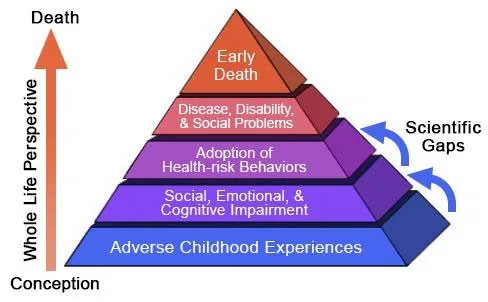
Adverse Childhood Experiences (ACEs) are stressful or traumatic events, including abuse (e.g. physical, sexual, or emotional/psychological) and neglect (e.g. physical or emotional). They may also include household dysfunction such as witnessing domestic violence (e.g. intimate partner violence, mother treated violently) or growing up with family members who have substance use disorders. Additional ACEs include household mental illness, parental separation/divorce, or incarcerated household members. ACEs are strongly related to the development and prevalence of a wide range of health problems throughout a person’s lifespan, including those associated with substance use. This is typically framed with respect to a pyramid, as shown.
Trauma-Informed Care (TIC)41
Trauma-Informed Care (TIC) is a framework for how providers and systems of care can work to reduce the likelihood of re-traumatization. Providing TIC does not require clinicians to ask for disclosures of trauma from patients, or to be experts in treating trauma symptoms. Trauma-informed principles can be applied to all clinical interactions to establish trust and to help patients to feel empowered. Core principle include safety, choice, collaboration, trustworthiness and empowerment. (See Appendix 1 for further information, including information on the Universal Precautions Approach)
Transference and Counter-transference42
- Transference is the unconscious redirection of a patient’s feelings, attitudes, and desires, often regarding a close personal relationship earlier in their life, onto the clinician.
- Countertransference is the unconscious redirection of a clinician’s feelings, attitudes, and desires about a close personal relationship onto the patient. This may mirror significant past conflicts experienced by the clinician.
- Transference phenomena is common in clinical care. It is not inherently pathologic, nor does it reflect failure on the part of the clinician or patient. Yet, if unrecognized, it can potentially lead to harmful consequences for patients and clinicians.
Care of the Elderly (COE)
Elder Abuse43
An intentional act (commission), or failure to act (omission) by a caregiver or another person in a relationship involving an expectation of trust that causes or creates a risk of harm to an older adult (defined as someone aged 60 or older). In addition to physical abuse, sexual abuse, emotional/psychological abuse, and neglect, elder abuse includes financial abuse or exploitation (the illegal, unauthorized, or improper use of an older individual’s resources by a caregiver or another person in a trusting relationship, for the benefit of someone other than the older individual. This includes depriving an older person of rightful access to, information about, or use of, personal benefits, resources, belongings or assets.
Polypharmacy44
Polypharmacy is the use of multiple medicines, where one or more medicines may be used to treat each condition in a patient with multimorbidity (i.e. having 2 or more chronic medical conditions). Although there is no standard definition for polypharmacy, the definition widely used in the literature is the regular use of at least 5 medications. Polypharmacy is associated with adverse outcomes including mortality, falls, adverse drug reactions, increased length of stay in hospital and readmission to hospital soon after discharge. The risk of adverse effects and harm increases with increasing numbers of medications. Harm can result due to a multitude of factors including drug-drug interactions and drug-disease interactions. Older patients can be at greater risk of adverse effects due to decreased renal and hepatic function, lower lean body mass, reduced hearing, vision, cognition and mobility.
Prescribing Cascade45
The use of a medication that results in an adverse drug event that is mistaken for a new diagnosis and treated with another medication, thus increasing the risk of further adverse drug events.
Indigenous Health
Indigenous46
An inclusive term to describe First Peoples, or the people whose ancestors lived for millennia on lands around the world prior to colonization. The term comes from the Latin indigena, meaning “sprung from the land; native.” The Indigenous peoples of Canada include First Nations, Inuit, and Métis.
Aboriginal46
A constitutional term created by the Canadian government that collectively refers to three groups: First Nations, Inuit and Métis. This is now primarily limited to legal contexts, where Indigenous is the most appropriate term.
First Nations46
In Canada, the accepted term for people who are Indigenous and who do not identify as Inuit or Métis is First Nations. First Nations people have lived and thrived since time immemorial on this land now called Canada. They have many different languages, cultures, traditions, and spiritual beliefs. Today, there are around 630 different First Nation communities across Canada - about half of which are in British Columbia and Ontario. According to the 2016 Census, there were 977,230 First Nations people in Canada, with over 70 distinct Indigenous languages recognized across the country.
Inuit46
Inuit are Indigenous Peoples living in the Arctic regions of Canada, Greenland, Alaska, and Russia. Inuit have lived and thrived in the Arctic for thousands of years. Inuit existed prior to contact and Inuit is the accepted term for people who are Indigenous and do not identify as First Nations or Métis. Approximately 65,000 Inuit live in Canada, according to the 2016 Census. The majority live in Nunavut, with smaller numbers in the other three regions of Inuit Nunangat, as well as a small number living in urban centres in southern Canada.
Métis46
The Métis are one of the Aboriginal peoples of Canada identified in Section 35 of the Constitution Act of 1982. The Métis are people who are Indigenous and do not identify as First Nations or Inuit. The Métis National Council defines Métis as a person who “self-identifies as Métis, as distinct from other Indigenous peoples, is of historic Métis Nation Ancestry and who is accepted by the Métis Nation.” According to the 2016 Census, there were 587,545 people identified as Métis in Canada.
Status Indian
Individuals who are registered under the Indian Act.
Non-Status Indian
Individuals who are First Nations who are not registered under the Indian Act.
Non-Insured Health Benefits47
Health benefits available for individuals who are registered under the Indian Act and Inuit people who are registered under the Nunavut Land Claim Agreement or the Inuvialuit Final Agreement. Non-insured health benefits include drug, dental, vision, medical transportation, and some mental health services.
Jordan’s Principle48
A legal rule that stipulates that when a First Nations child is in need of services the government department of first contact is required to cover the costs and can apply for reimbursement from other governmental organizations after the child has received care. This rule is intended to prevent delays in services provided to First Nations children resulting from jurisdictional disputes. Jordan’s Principle is named in honour of Jordan River Anderson.
Colonialism649
As detailed in the Truth and Reconciliation Commission Final Report: For over a century, the central goals of Canada’s Aboriginal policy were to eliminate Aboriginal governments; ignore Aboriginal rights; terminate the Treaties; and, through a process of assimilation, cause Aboriginal peoples to cease to exist as distinct legal, social, cultural, religious and racial entities in Canada. The establishment and operation of residential schools were a central element of this policy, which can best be described as “cultural genocide”.
Colonial policies including mandatory residential schools, the outlawing of Indigenous gatherings and ceremonies, forced community dislocations, and discriminatory child welfare legislation have had lasting and intergenerational effects on mental health, family relationships, and Indigenous Language and Culture. Colonialism remains an ongoing process, shaping both the structure and the quality of the relationship between the settlers and Indigenous peoples.
Reconciliation49
The Truth and Reconciliation Commission of Canada’s mandate describes reconciliation as “an ongoing individual and collective process, and will require commitment from all those affected including First Nations, Inuit and Métis former Indian Residential School (IRS) students, their families, communities, religious entities, former school employees, government and the people of Canada. Reconciliation may occur between any of the above groups.” The concept of reconciliation means different things to different people, communities, institutions and organizations. Reconciliation is an ongoing process of establishing and maintaining respectful relationships. A critical part of this process involves repairing damaged trust by making apologies, providing individual and collective reparations, and following through with concrete actions that demonstrate real societal change. Establishing respectful relationships also requires the revitalization of Indigenous law and legal traditions. It is important that all Canadians understand how traditional First Nations, Inuit, and Métis approaches to resolving conflict, repairing harm, and restoring relationships can inform the reconciliation process.
Occupational Health
Workplace Safety and Insurance Board (WSIB)50
For workers who are injured at work, the WSIB provides Loss of Earning (LOE) benefits and healthcare coverage. For employers, the WSIB provides no-fault collective liability insurance, and access to industry-specific health and safety information. For both workers and employers, the WSIB provides help and support in return to work after an injury.
Workplace51
Any land, premises, location or thing at, upon, in or near which a worker works.
Worker5152
A person who performs work or supplies services for monetary compensation; or a person who performs work or supplies services for no monetary compensation (either a work experience program authorized by a secondary school board; or a program approved by a post-secondary institution). Of note, inmates of correctional institutions are not considered workers by the Occupational Health and Safety Act (OHSA).
- Worker’s rights: Include the right to refuse unsafe work, to participate in workplace health and safety activities, and to know actual and potential dangers in the workplace.
- Worker’s responsibilities: To work in compliance with the Occupational Health and Safety Act and regulations; to use personal protective equipment (PPE) and clothing as directed by the employer; and to report workplace hazards and dangers.
Supervisor5152
A person who either has charge of a workplace, or authority over a worker.
- Supervisor’s responsibilities: To ensure that workers use prescribed protective equipment devices; to advise workers of potential and actual hazards; and to take every reasonable precaution in the circumstances for the protection of workers.
Employer5152
A person who employs one or more workers or contracts for services of one or more workers; includes a contractor or subcontractor who performs work or supplies services.
- Employer’s responsibilities: To establish and maintain a joint health and safety committee, or cause workers to select at least one health and safety representative; to take every reasonable precaution to ensure the workplace is safe; to train employees about any potential hazards; to supply personal protective equipment and ensure workers know how to use the equipment safely and properly; to immediately report all critical injuries to the government department responsible for Occupational Health and Safety; and to train all employees on how to safely use, handle, store and dispose of hazardous substances and handle emergencies.
Health of Rural Populations
Population Centres53
A population centre has a population of at least 1,000 and a population density of 400 persons or more per square kilometer. All areas outside population centres are classified as rural areas. Population centres are classified into three groups, depending on the size of their population:
- Small Population Centres: Population between 1,000 and 29,999
- Medium Population Centres: Population between 30,000 and 99,999
- Large Urban Population Centres: Population of 100,000 or more.
Rural & Small Town54
Rural can be defined functionally by looking at the degree to which an area is integrated into an urban labour market, descriptively by looking at population densities, or sociologically by looking at shared cultural attributes or communities of interests. Rural areas are defined as all territory lying outside population centres.
Rural Practice55
Medical practice outside urban areas, where the location of the practice obliges some general practitioners to have, or to acquire, procedural and other skills not usually required in urban practice.
Patients with a History of Incarceration
UN Nelson Mandela Rules56
The UN Standard Minimum Rules for the Treatment of Prisoners (Nelson Mandela Rules) specific to health includes the stipulation that prisoners shall have access to health services available in the country without discrimination on the grounds of their legal situation.
Restorative vs. Retributive Justice57
| Retributive Justice | Restorative Justice |
|---|---|
| Crime is an act against the state, a violation of a right, an abstract idea | Crime is an act against another person and the community |
| Crime control lies with the criminal justice system | Crime control lies primarily in the community |
| Offender accountability defined as taking punishment | Offender accountability defined as assuming responsibility and taking action to repair harm |
| Crime is an individual act with individual responsibility | Crime has both individual and social dimensions of responsibility |
| Punishment is effective; threats of punishment deter crime, and punishment changes behavior | Punishment alone is not effective in changing behavior and is disruptive to community harmony and good relationships |
| Victims are peripheral to the process | Victims are central to process of resolving crime |
| Offender defined by deficits | Offender defined by capacity to make reparation |
| Focus on establishing blame or guilt, on the past (did they do it?) | Focus on problem solving, on liabilities, on obligations, on future (what should be done?) |
| Emphasis on adversarial relationship | Emphasis on dialogue and negotiation |
| Imposition of pain to punish and deter/prevent | Restitution as a means of restoring both parties; goal of reconciliation/restoration |
| Community on sideline, represented abstractly by state | Community as facilitator in restorative process |
| Response focused on offender’s past behavior | Response focused on harmful consequences of offender’s behavior; emphasis is on the future |
| Dependence upon proxy individuals | Direct involvement by participants |
Recidivism58
A person’s relapse into criminal behavior, often after the person receives sanctions or undergoes intervention for a previous crime.
Correctional Institution59
Where an individual who is convicted of a crime serves sentences. If sentence less than 2 years’ duration → Provincial/Territorial Institution. If sentence greater than 2 years → Federal institution
Parole60
Allows an individual who is convicted to serve part of a prison sentence in community. In full parole, the person does not return nightly to an institution, but must report directly to a parole supervisor, and in some cases, to the police. In day parole, the person has the opportunity to participate in ongoing community-based activities, and ordinarily reside at a correctional institution or community residence.
Probation61
A court disposition authorizing a person who is convicted to remain in the community subject to conditions prescribed in a probation order (e.g. reporting to probation officer within a set schedule).
Patients with Addictions
Harm Reduction6263
Harm Reduction refers to policies, programs and practices that aim to minimize negative health, social and legal impacts associated with drug use, drug policies and drug use. Harm reduction is grounded in justice and human rights – it focuses on positive change and on working with people without judgment, coercion, discrimination, or requiring that they stop using drugs as a precondition of support. Principles of Harm Reduction include respecting the rights of people who use drugs; a commitment to evidence; a commitment to social justice and collaborating with networks of people who use drugs; and the avoidance of stigma. Goals of Harm Reduction include keeping people alive and encouraging positive change in their lives; reducing the harms of drug laws and policy; and offering alternatives to approaches that seek to prevent or end drug use.62 A recent paper describes 6 principles of Harm Reduction which can be generalized to working with other chronic conditions: Humanism; Pragmatism; Individualism; Autonomy; Incrementalism; and Accountability without termination.63
Syringe Services Programs (SSPs)64
Community-based programs that provide access to sterile needles and syringes free of cost and facilitate safe disposal of used needles and syringes. Also called needle exchange programs (NEPS).
Overdose Prevention Programs65
Public programs to provide easy-to-access, life-saving Naloxone medication (e.g. free Naloxone kits). Naloxone is available as part of Supervised Consumption Services.
Supervised Consumption Services66
Evidence-based health services that provide a safe and hygienic place for people to use drugs while supervised by trained staff. The drug itself is provided by the person using it. These resources connect people to health and social services; provide harm reduction supports such as sterile equipment, encourage safer drug use; and administer naloxone in the event of opioid overdose. Often called Safe Injection sites.
Oral Opioid Agonist Therapy (OAT)67
Part of the spectrum of care for patients with opioid use disorder (OUD). OAT has been shown to be more effective to withdrawal management alone in terms of treatment retention, sustained abstinence from opioid use, and reduced risk of morbidity and mortality. Treatment is prescribed by a physician. Buprenorphine/ Naloxone (Suboxone) is the recommended first-line treatment for OUD in adults, and youth >12yo with moderate/severe OUD. Methadone is the recommended second-line opioid agonist treatment if induction with buprenorphine/naloxone is contraindicated or not preferred.
Safe Supply Program68
An emerging part of the spectrum of care for patients with opioid use disorder (OUD), typically indicated for patients who have taken Oral Opioid Agonist Therapy and not been successful in treatment. Safer supply refers to providing prescribed medications by a physician or nurse practitioner. The intent is to provide a safer alternative to meet the existing needs of people who use drugs, reduce the risk of overdose by helping people to be less reliant on the toxic illegal drug supply, and provide connections to health and social services where possible and appropriate. Medications prescribed are most commonly tablet hydromorphone, with other options including injectable hydromorphone (also called Injectable Opioid Agonist Therapy, iOAT programs), fentanyl patches, or tablet oxycodone.
Health of Immigrant and Refugee Populations
Economic Immigrant6970
Immigrants selected by the government (Immigration, Refugees and Citizenship Canada, collaborating with provincial governments) for their ability to contribute to Canada's economy through their ability to meet labour market needs, to own and manage or to build a business, to make a substantial investment, to create their own employment or to meet specific provincial or territorial labour market needs. Note that in Quebec, the province has exclusive authority over selection of economic immigrants destined to the province.
Immigrant Sponsored by Family70
Immigrants sponsored by a Canadian citizen or permanent resident and granted permanent resident status on the basis of their relationship either as the spouse, partner, parent, grand-parent, child or other relative of this sponsor. The terms "family class" or "family reunification" are sometimes used to refer to this category.
Geneva Convention Refugee Abroad Class71
Persons who are outside of their home country and cannot return there due to a well-founded fear of persecution based on race, religion, political opinion, nationality, or membership in a particular social group (e.g. gender, sexual orientation, etc.). Divided into government-assisted refugees (sponsored by Government of Canada), privately sponsored refugees, or blended visa office-referred refugees (mix of sponsorship by Government of Canada and private).
Country of Asylum Refugee Class71
Persons who are outside your home country or the country where you normally live and have either (1) been seriously affected by civil war or armed conflict, or (2) been denied basic human rights on an ongoing basis. May be sponsored by the Government of Canada, or Privately sponsored.
Refugee Claimant71
A person who claims refugee protection in Canada.
Canada-US Safe Third Country Agreement72
An agreement signed between Canada and the United States in December 2004. Under this agreement, refugee claimants are required to request refugee protection in the first safe country they arrive in, unless they qualify for an exception to the Agreement (e.g. family member, unaccompanied minor, document holder, and public interest exceptions). This agreement is in effect for refugee claimants seeking entry to Canada from the United States at land border crossings, by train, or at airports (where the claimant was first refused refugee status in the United States and is in transit through Canada following being deported from the United States).
Informal Interpreters73
Also called “Ad-Hoc” Interpreters (e.g. friends, family). Family members and friends should not take the place of professional interpreters because they may: lack fluency in the language; add/omit/alter information; filter information in the belief they are protecting the patient; editorialize; be emotionally involved, be uncomfortable interpreting sensitive issues; not respect confidentiality; have a conflict of interest; or misuse information. It is especially important to not rely on children to act as interpreters, which can cause unacceptable strain.
Community Interpreters73
A bilingual, bicultural consecutive interpreter working in community and social service settings. Interpretation may occur on-site, or via telephone or video interpretation services. Interpreters are bound by a code of ethics including confidentiality, accuracy, impartiality, and disclosure of any conflict of interest.
References
-
Glossary. Rainbow Health Ontario. Accessed March 11, 2019. https://www.rainbowhealthontario.ca/glossary/#I ↩ ↩2 ↩3 ↩4 ↩5 ↩6 ↩7 ↩8 ↩9 ↩10 ↩11 ↩12 ↩13 ↩14 ↩15 ↩16 ↩17 ↩18 ↩19 ↩20 ↩21 ↩22 ↩23 ↩24 ↩25 ↩26 ↩27 ↩28 ↩29 ↩30 ↩31 ↩32 ↩33 ↩34 ↩35 ↩36 ↩37 ↩38 ↩39 ↩40 ↩41 ↩42 ↩43 ↩44 ↩45
-
Renfrow DG. A cartography of passing in everyday life. Symb Interact. 2004;27(4):485-506. ↩
-
Canadian Public Health Association. Discussing Sexual Health, Substance Use and STBBIs. 2017. ↩ ↩2 ↩3 ↩4 ↩5
-
Allyship. The Anti-Oppression Network. Accessed June 5, 2022. https://theantioppressionnetwork.com/allyship/ ↩
-
Myth of Reverse Racism. aclrc.com. Accessed March 11, 2019. http://www.aclrc.com/myth-of-reverse-racism ↩ ↩2
-
College of Family Physicians of Canada. Health and Healthcare Implications of Systemic Racism on Indigenous Peoples in Canada: Indigenous Health Working Group Fact Sheet. 2016. ↩ ↩2 ↩3 ↩4 ↩5
-
Rodriguez F. Passing vs. Non-Passing: Latina/o/x Experiences and Understandings of Being Presumed White. Electronic Theses, Projects and Dissertations 1121. 2020. ↩
-
povertyinstitute.ca. Accessed March 13, 2019. https://www.povertyinstitute.ca/poverty-canada ↩
-
Homeless Hub. Accessed March 12, 2019. https://www.homelesshub.ca/sites/default/files/COHhomelessdefinition-1pager.pdf ↩
-
Accessed March 12, 2019. https://goo.gl/orGpq3 ↩
-
Housing First. Homeless Hub. Accessed June 20, 2021. https://www.homelesshub.ca/about-homelessness/homelessness-101/housing-first ↩ ↩2
-
Government of Canada. Accessed March 12, 2019. https://www.canada.ca/en/health-canada/services/food-nutrition/food-nutrition-surveillance/health-nutrition-surveys/canadian-community-health-survey-cchs/household-food-insecurity-canada-overview.html ↩ ↩2
-
Rollnick S, Miller W. What is motivational interviewing? Behav Cogn Psychother. 1995;23:325-334. ↩
-
health.mo.gov. Accessed March 13, 2019. https://health.mo.gov/living/healthcondiseases/chronic/wisewoman/pdf/MIPrinciplesofMI.pdf ↩
-
Behavioral Change Theories. sphweb.bumc.bu.edu. Accessed June 20, 2021. https://sphweb.bumc.bu.edu/otlt/mph-modules/sb/behavioralchangetheories/BehavioralChangeTheories6.html ↩
-
Weight Bias. Obesity Canada. Accessed March 13, 2019. https://obesitycanada.ca/weight-bias/ ↩ ↩2 ↩3
-
Fatphobia. bmc.org. Accessed June 5, 2022. https://www.bmc.org/glossary-culture-transformation/fatphobia ↩
-
Definitions. Access Ontario. Accessed March 13, 2019. https://accessontario.com/aoda/definitions/ ↩ ↩2 ↩3 ↩4
-
Brown I, Wehmeyer ML, Shogren KA. What is meant by the terms intellectual disability and developmental disabilities? In: A Comprehensive Guide to Intellectual and Developmental Disabilities. 2nd ed. Brookes; 2017:7-18. ↩ ↩2
-
What Is Neurodiversity? health.harvard.edu. Accessed June 5, 2022. https://www.health.harvard.edu/blog/what-is-neurodiversity-202111232645 ↩
-
Neurodiversity and Other Conditions. ADHD Aware. Accessed June 5, 2022. https://adhdaware.org.uk/what-is-adhd/neurodiversity-and-other-conditions/ ↩
-
utm.utoronto.ca. Accessed March 12, 2019. https://www.utm.utoronto.ca/accessibility/models-disability ↩
-
Sullivan W, et al. Primary care of adults with intellectual and developmental disabilities: 2018 Canadian consensus guidelines. Can Fam Physician. 2018;64:254-279. ↩
-
People First Language. odr.dc.gov. Accessed June 20, 2021. https://odr.dc.gov/page/people-first-language ↩
-
Asexuality, Attraction, and Romantic Orientation. lgbtq.unc.edu. Accessed June 5, 2022. https://lgbtq.unc.edu/resources/exploring-identities/asexuality-attraction-and-romantic-orientation/ ↩ ↩2
-
Transgender. Planned Parenthood. Accessed June 5, 2022. https://www.plannedparenthood.org/learn/gender-identity/transgender ↩
-
van Anders SM, Galupo MP, Irwin J, et al. Talking about transgender experiences, identities, and existences. 2019. ↩ ↩2 ↩3 ↩4 ↩5
-
Cocchetti C, et al. Hormonal treatment strategies tailored to non-binary transgender individuals. J Clin Med. 2020;9(6):1609. ↩
-
Rosendale N, et al. Acute clinical care for transgender patients: a review. JAMA Intern Med. 2018;178(11):1535-1543. ↩ ↩2 ↩3 ↩4 ↩5 ↩6
-
Celebrating Our Magic Toolkit. Healthy Native Youth. Accessed June 5, 2022. https://www.healthynativeyouth.org/wp-content/uploads/2021/05/Celebrating-Our-Magic-Toolkit.pdf ↩
-
Gender Inclusive Language in Perinatal Services. bsuh.nhs.uk. Accessed June 6, 2022. https://www.bsuh.nhs.uk/maternity/wp-content/uploads/sites/7/2021/01/Gender-inclusive-language-in-perinatal-services.pdf ↩
-
Terms and Phrases to Avoid. Alberta Health Services. Accessed June 5, 2022. https://www.albertahealthservices.ca/assets/info/pf/div/if-pf-div-terms-and-phrases-to-avoid.pdf ↩ ↩2
-
Intimate Partner Violence. Centers for Disease Control and Prevention. Accessed March 8, 2019. https://www.cdc.gov/violenceprevention/pdf/intimatepartnerviolence.pdf ↩ ↩2 ↩3 ↩4 ↩5 ↩6 ↩7 ↩8 ↩9
-
Gold A. Halsbury’s Laws of Canada – Criminal Offences and Defences (2016). 2016. Section HCR-211, Sexual Assault. ↩
-
Child Maltreatment. World Health Organization. Accessed March 8, 2019. https://www.who.int/en/news-room/fact-sheets/detail/child-maltreatment ↩
-
Norman R, et al. The long-term health consequences of child physical abuse, emotional abuse, and neglect: a systematic review and meta-analysis. PLoS Med. 2012;9(11):e1001349. ↩ ↩2 ↩3 ↩4
-
Substance Abuse and Mental Health Services Administration. Accessed March 8, 2019. https://www.samhsa.gov/trauma-violence ↩
-
Complex Trauma. National Child Traumatic Stress Network. Accessed March 8, 2019. https://www.nctsn.org/what-is-child-trauma/trauma-types/complex-trauma ↩
-
Saakvitne KW, Pearlmean LA. Transforming the Pain: A Workbook on Vicarious Traumatization. W.W. Norton and Co; 1996. ↩
-
Substance Abuse and Mental Health Services Administration. Accessed March 14, 2019. https://integration.samhsa.gov/about-us/ACES_in_TIC.pdf ↩
-
What Is Trauma-Informed Care. socialwork.buffalo.edu. Accessed November 7, 2023. https://socialwork.buffalo.edu/social-research/institutes-centers/institute-on-trauma-and-trauma-informed-care/what-is-trauma-informed-care.html ↩
-
Transference and Countertransference in Palliative Care. mypcnow.org. Accessed June 5, 2022. https://www.mypcnow.org/fast-fact/transference-and-countertransference-in-palliative-care/#:~:text=Counter%2Dtransference%20is%20the%20unconscious,strategies%20to%20mitigate%20their%20consequences. ↩
-
Centers for Disease Control and Prevention. Accessed March 8, 2019. https://www.cdc.gov/violenceprevention/elderabuse/definitions.html ↩
-
Halli-Tierney AD, et al. Polypharmacy: evaluating risks and deprescribing. Am Fam Physician. 2019;100(1):32-38. ↩
-
Gokula M, Holmes H. Tools to reduce polypharmacy. Clin Geriatr Med. 2012;28:323-341. ↩
-
First Nations. BCcampus. Accessed June 5, 2022. https://bccampus.ca/2019/10/11/first-nations/ ↩ ↩2 ↩3 ↩4 ↩5
-
Indigenous Services Canada. Accessed June 5, 2022. https://www.sac-isc.gc.ca/eng/1585310583552/1585310609830 ↩
-
Indigenous Services Canada. Accessed June 5, 2022. https://www.sac-isc.gc.ca/eng/1583700168284/1583700212289 ↩
-
Truth and Reconciliation Commission of Canada. Honouring the Truth, Reconciling for the Future: Summary of the Final Report of the Truth and Reconciliation Commission of Canada. 2015. ↩ ↩2
-
Workplace Safety and Insurance Board. Accessed March 13, 2019. https://www.wsib.ca/en/policy ↩
-
Government of Ontario. Accessed March 13, 2019. https://www.ontario.ca/document/guide-occupational-health-and-safety-act/about-act ↩ ↩2 ↩3 ↩4
-
Canadian Centre for Occupational Health and Safety. Accessed March 13, 2019. https://www.ccohs.ca/headlines/text43.html ↩ ↩2 ↩3
-
Statistics Canada. Accessed June 5, 2022. https://www.statcan.gc.ca/en/subjects/standard/pcrac/2016/introduction ↩
-
Senate of Canada. Accessed June 5, 2022. https://sencanada.ca/content/sen/committee/391/agri/rep/repintdec06-e.htm#_Toc153016141 ↩
-
College of Family Physicians of Canada. Review of Family Medicine Within Rural and Remote Canada: Education, Practice and Policy. 2016. ↩
-
Office of the United Nations High Commissioner for Human Rights. Accessed March 13, 2019. https://www.ohchr.org/en/professionalinterest/pages/basicprinciplestreatmentofprisoners.aspx ↩
-
Retribution vs. Restoration. cscsb.org. Accessed June 5, 2022. https://cscsb.org/retribution-vs-restoration/ ↩
-
Recidivism. National Institute of Justice. Accessed March 14, 2019. https://www.nij.gov/topics/corrections/recidivism/pages/welcome.aspx ↩
-
Correctional Service Canada. Accessed June 5, 2022. https://www.csc-scc.gc.ca/media-room/009-0002-eng.shtml ↩
-
Government of Canada. Accessed June 20, 2021. https://www.canada.ca/content/dam/canada/parole-board/migration/001/093/001-0007_en.pdf ↩
-
Probation and Parole. Government of Ontario. Accessed June 5, 2022. https://www.ontario.ca/page/probation-and-parole#section-5 ↩
-
What Is Harm Reduction. Harm Reduction International. Accessed March 13, 2019. https://www.hri.global/what-is-harm-reduction ↩ ↩2
-
Hawk M, et al. Harm reduction principles for healthcare settings. Harm Reduct J. 2017;14:70. ↩ ↩2
-
Centers for Disease Control and Prevention. Accessed March 13, 2019. https://www.cdc.gov/hiv/risk/ssps.html ↩
-
health.gov.on.ca. Accessed March 13, 2019. http://www.health.gov.on.ca/en/news/bulletin/2018/hb_20180111.aspx ↩
-
Alberta Health Services. Accessed June 20, 2021. https://www.albertahealthservices.ca/info/Page15434.aspx ↩
-
actt.albertadoctors.org. Accessed June 20, 2021. https://actt.albertadoctors.org/file/phc-ori-integration-of-oat-rapid-review-2018-07-23.pdf ↩
-
Safer Supply. Government of Canada. Accessed June 5, 2022. https://www.canada.ca/en/health-canada/services/opioids/responding-canada-opioid-crisis/safer-supply.html ↩
-
Economic Immigration. Government of Canada. Accessed June 5, 2022. https://www.canada.ca/en/immigration-refugees-citizenship/corporate/transparency/transition-binders/minister-2021/economic-immigration.html ↩
-
Accessed March 14, 2019. https://goo.gl/BwwVRh ↩ ↩2
-
Accessed March 14, 2019. https://goo.gl/BuVc7m ↩ ↩2 ↩3
-
Accessed March 14, 2019. https://goo.gl/wuakwZ ↩
-
Guide to Working With Interpreters. cisoc.net. Accessed June 20, 2021. http://www.cisoc.net/_files/Guide_to_Working_with_Interpreters.pdf ↩ ↩2